
Walking is one of the simplest, most accessible ways to lose weightbut one question comes up again and again: how many steps per day do you actually need to lose weight?
You’ve probably heard the popular advice to aim for 10,000 steps daily, but is that number backed by science, or is it just a fitness myth?
The truth is, weight loss through walking isn’t about chasing a magic step countit’s about consistency, calorie balance, and finding a goal that fits your lifestyle.
Whether you’re just starting your weight-loss journey or looking for a sustainable way to stay active, understanding how daily steps impact fat loss can help you set realistic expectations and avoid frustration.
In this guide, we’ll break down the science behind steps and weight loss, explain how many steps are ideal for different fitness levels, and show you how to use walking effectivelywithout overcomplicating things.
By the end, you’ll know exactly how to turn your daily steps into real, lasting results.
What Does “Steps Per Day” Really Mean?
When people talk about “steps per day,” they’re referring to the total number of steps you take across an entire daynot just during a workout or dedicated walk. This includes every form of movement, from walking to your car and doing household chores to intentional exercise like brisk walking or treadmill sessions. All of these steps add up and contribute to your overall daily activity level.
Steps are especially valuable because they capture something many traditional workouts miss: non-exercise activity, often called everyday movement. Even small actionsstanding up more often, pacing while on the phone, or taking the stairscan significantly increase your daily step count and calorie burn over time. This is why two people with the same workout routine may see different weight-loss results depending on how active they are for the rest of the day.
It’s also important to understand that not all steps are equal. A slow stroll around the house burns fewer calories than a brisk walk that raises your heart rate. However, both still count toward your total movement and help reduce long periods of sitting, which is linked to weight gain and poor metabolic health.
Rather than viewing steps as a rigid fitness rule, it’s more helpful to think of them as a simple measurement of daily movement. Tracking steps gives you a clear, easy-to-understand way to stay active, build consistency, and gradually increase your activity levelkey factors for sustainable weight loss.
The Science Behind Steps and Weight Loss
Weight loss ultimately comes down to one fundamental principle: burning more calories than you consume. Walking helps create this calorie deficit by increasing the amount of energy your body uses throughout the day. Every step you take requires muscle activation, oxygen, and fuel, which means even moderate increases in daily movement can have a meaningful impact over time.
One of the biggest advantages of walking is that it boosts your daily energy expenditure without placing excessive stress on your body. Unlike high-intensity workouts, walking is sustainable for most people, making it easier to stay consistenta critical factor in long-term weight loss. Research shows that people who maintain higher daily step counts tend to have better weight management and lower body fat levels, even when their exercise routines are simple.
Steps also play a major role in increasing non-exercise activity thermogenesis (NEAT). NEAT includes all the calories you burn outside of structured workouts, such as standing, moving around at work, or doing household tasks. For many individuals, NEAT can account for a large portion of daily calorie burn, sometimes even more than formal exercise.
However, steps alone don’t guarantee weight loss. If calorie intake increases alongside activity, the calorie deficit disappears. This is why walking works best when paired with mindful eating habits and realistic expectations. Over time, consistently increasing your daily stepscombined with proper nutritionhelps your body burn more calories, improve metabolic health, and support steady, sustainable weight loss without extreme dieting or exhausting workouts.
How Many Steps Per Day Do You Need to Lose Weight?
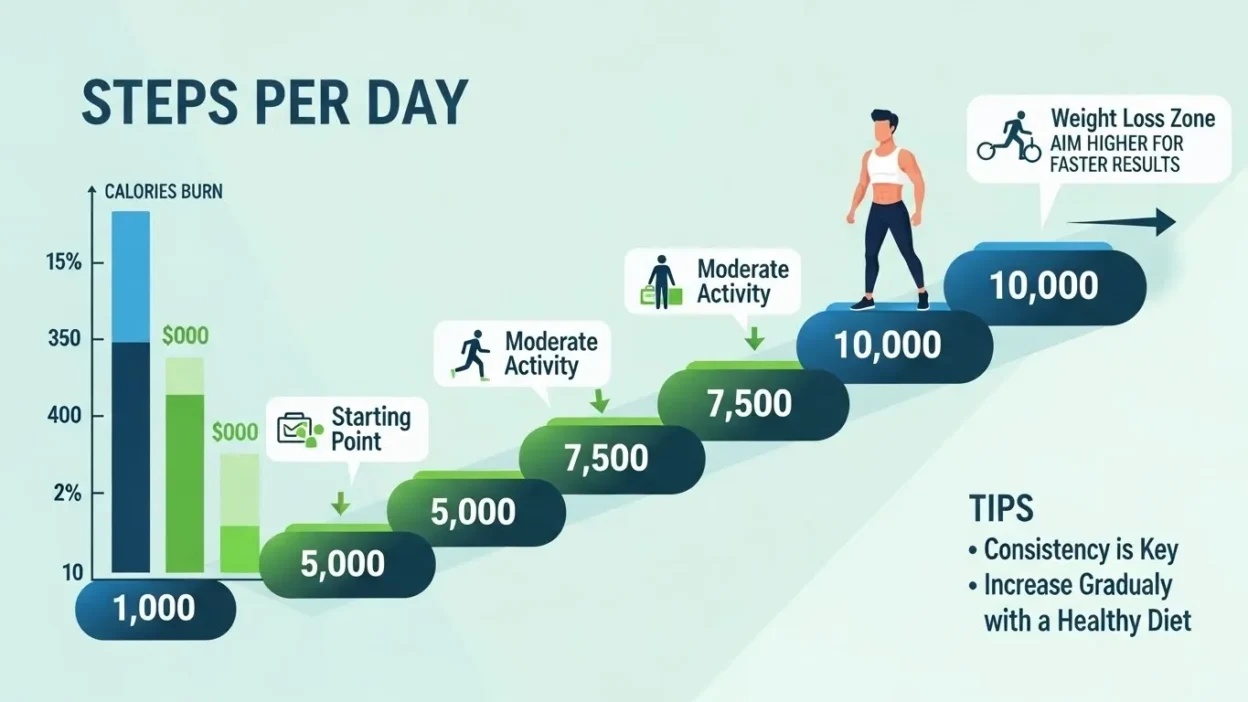
There isn’t a single step number that guarantees weight loss for everyone, but research and real-world data provide helpful ranges. Most people who live a sedentary lifestyle average around 3,000 to 4,000 steps per day, which is usually not enough to support weight loss. Increasing daily steps beyond this baseline is often the first meaningful change that leads to results.
For many individuals, 7,000 to 9,000 steps per day is an effective range for fat loss when combined with a calorie-controlled diet. This level of activity significantly boosts daily calorie burn without being overwhelming or difficult to maintain. Studies suggest that even modest increases in stepssuch as going from 4,000 to 7,000 per daycan improve body composition and overall health.
The popular 10,000-step goal is often seen as the gold standard, but it’s not a requirement. While hitting 10,000 steps can increase calorie expenditure and improve cardiovascular fitness, weight loss can occur well below that number if nutrition is aligned. In fact, pushing too aggressively toward high step counts can lead to fatigue, joint discomfort, or burnout, especially for beginners.
The most important factor is consistency. A realistic step goal that you can maintain daily will always outperform an ambitious target you can only hit occasionally. Instead of chasing a perfect number, focus on gradually increasing your average daily steps and pairing them with healthy eating habits for steady, sustainable weight loss.
Steps Per Day Based on Your Fitness Level
Your ideal daily step count for weight loss depends largely on your current fitness level and lifestyle. Starting where you arenot where you think you should beis key to avoiding injury and staying consistent.
Beginners or those with a mostly sedentary routine often average fewer than 5,000 steps per day. For this group, a realistic and effective goal is to aim for 5,000 to 6,000 steps daily. This increase alone can significantly boost calorie burn and improve energy levels. The focus should be on building a habit rather than maximizing steps.
Intermediate walkers, who already move regularly, may benefit from targeting 7,000 to 9,000 steps per day. At this level, walking starts to meaningfully contribute to fat loss, especially when paired with brisk pacing or longer walking sessions. Adding short bursts of faster walking can further increase calorie expenditure without extending walking time.
Advanced or highly active individuals may aim for 10,000 to 12,000 steps per day, particularly if weight loss has stalled. However, beyond a certain point, increasing steps delivers diminishing returns. Extremely high step counts can also increase fatigue and recovery demands, making it harder to maintain consistency.
No matter your level, progression matters more than perfection. Increasing your step count graduallyby 500 to 1,000 steps at a timeallows your body to adapt safely. The goal is not to walk as much as possible, but to walk enough to support a sustainable calorie deficit while fitting naturally into your daily routine.
Factors That Affect How Many Steps You Need
While step-count guidelines provide helpful benchmarks, the exact number of steps needed for weight loss varies from person to person. Several key factors influence how effective your daily steps are at burning calories and supporting fat loss.
Body weight and composition play a major role. Heavier individuals generally burn more calories per step because moving a larger body requires more energy. As weight decreases, the number of calories burned per step may also decline, which is why step goals sometimes need adjustment over time.
Walking speed and intensity also matter. A brisk walk that elevates your heart rate burns more calories than slow, casual walking. Two people may take the same number of steps, but the one walking faster or including hills will burn more energy.
Terrain and environment can significantly impact calorie burn. Walking uphill, on uneven surfaces, or on stairs increases muscle engagement and energy expenditure compared to flat ground. Even small changes in route can make your steps more effective.
Age and metabolic rate influence results as well. Metabolism naturally slows with age, which may require either more steps or additional lifestyle adjustments to maintain a calorie deficit. Hormonal changes can also affect how the body responds to activity.
Finally, diet and overall lifestyle are critical. Steps work best when paired with mindful eating, adequate protein intake, proper sleep, and stress management. If calorie intake consistently exceeds what you burn, even high step counts may not lead to weight loss. Understanding these factors helps you tailor your step goals to your body and lifestyle for better, more sustainable results.
How Many Calories Do Steps Burn?
The number of calories burned through walking depends on several variables, which is why there’s no single, exact answer. On average, most people burn about 0.04 to 0.06 calories per step, but this can vary widely based on body weight, walking speed, and terrain. For example, a heavier person walking briskly will burn more calories per step than a lighter person walking slowly.
To put this into perspective, 5,000 steps may burn roughly 200–300 calories, while 10,000 steps can burn 400–600 calories for many individuals. These estimates are useful as general guidelines, but they shouldn’t be treated as precise measurements. Fitness trackers and smartphone apps often provide calorie estimates, yet these tools rely on algorithms that may not fully account for individual differences.
What makes steps particularly effective for weight loss is their cumulative effect. Burning an extra 200 calories per day through walking can result in meaningful fat loss over weeks and months when paired with a consistent calorie deficit. Unlike intense workouts that may only occur a few times per week, daily steps contribute to calorie burn every single day.
It’s also important to note that walking has a lower recovery cost compared to high-intensity exercise. This means you can walk more frequently without excessive fatigue, making it easier to maintain a steady calorie burn over time. While tracking calories burned from steps can be motivating, focusing on long-term consistency and overall activity level will always be more effective than chasing exact numbers.
Walking Speed vs Step Count: What Matters More?
Both walking speed and step count influence weight loss, but they play slightly different roles. Step count measures how much you move throughout the day, while walking speed reflects how intensely your body is working during those steps. Understanding the balance between the two can help you get better results without needing to walk for hours.
Walking at a brisk pace increases heart rate, breathing, and calorie burn compared to slow, casual walking. Fewer fast steps can sometimes burn as manyor morecalories than a larger number of slow steps. This is why structured walks at a moderate to fast pace are often recommended for fat loss.
That said, step count remains extremely important, especially for beginners. Simply increasing daily movement from a sedentary level can lead to significant health and weight-loss benefits, even if the walking pace is relatively slow. For many people, focusing on total steps first helps build consistency and reduces the pressure to “work out.”
Ideally, the most effective approach combines both. Aim to increase your overall daily steps while including short periods of faster walking. For example, you might walk at a comfortable pace most of the day but add 10–20 minutes of brisk walking during a dedicated walk or commute.
It’s also worth noting that walking speed naturally increases as fitness improves. What once felt brisk may later feel easy, allowing you to walk faster or longer without extra effort. Rather than choosing between speed and steps, think of them as complementary toolstogether, they create a sustainable and effective strategy for long-term weight loss
Can You Lose Weight by Walking Alone?
Walking can absolutely lead to weight loss, especially for beginners or those returning to physical activity after a long break. By increasing daily movement, walking raises your overall calorie burn and helps create the calorie deficit needed for fat loss. For many people, simply becoming more active through walking is enough to start seeing changes on the scale.
However, walking alone has its limits. As your body adapts, weight loss may slow if calorie intake remains high or if walking intensity stays the same. This is why some people experience early success with walking but later hit a plateau. Weight loss isn’t just about movementit’s about balancing activity with nutrition and overall lifestyle habits.
Combining walking with mindful eating significantly improves results. Paying attention to portion sizes, prioritizing whole foods, and ensuring adequate protein intake can help maintain muscle mass while losing fat. Protein, in particular, supports satiety and prevents muscle loss during weight loss.
Adding strength training alongside walking can also make a big difference. Strength exercises help preserve lean muscle, boost metabolism, and improve body composition. Even two short strength sessions per week can enhance fat-loss results without interfering with your walking routine.
Walking is best viewed as a foundation rather than a standalone solution. It’s low-impact, accessible, and easy to sustain long term. When paired with proper nutrition and basic strength training, walking becomes a powerful tool for sustainable weight loss, improved health, and better overall fitnesswithout the burnout often associated with more intense exercise programs.
How to Increase Your Daily Steps (Practical Tips)
Increasing your daily steps doesn’t require drastic lifestyle changes or long workout sessions. Small, intentional adjustments can add thousands of steps to your day without feeling overwhelming.
Start by breaking movement into short walks. A 5–10 minute walk after meals, during breaks, or in the evening can quickly add up. These short walks are easier to maintain than one long session and can also support digestion and blood sugar control.
Look for opportunities to build steps into your routine. Park farther away, take the stairs instead of the elevator, or walk while talking on the phone. Household tasks such as cleaning, cooking, or organizing also contribute to your daily step total.
If you work at a desk, set a reminder to stand up and move every hour. Even a quick lap around your home or office can help reduce long periods of sitting and increase overall activity. Using a step tracker or smartphone app can make this process more motivating by providing immediate feedback.
For added effectiveness, turn some of your steps into intentional walking sessions. A brisk 20–30 minute walk a few times per week can significantly increase calorie burn and cardiovascular benefits. Walking with music, podcasts, or a friend can also make the habit more enjoyable.
The key is consistency. Focus on gradually increasing your average daily steps rather than aiming for perfection every day. Over time, these small changes become habits that support long-term weight loss and overall health.
Weekly Step Goals vs Daily Perfection
Many people struggle with weight loss because they focus too much on hitting a perfect step count every single day. In reality, weekly step averages matter far more than daily perfection. Life happensbusy workdays, travel, illness, or rest days can all cause fluctuations in your daily activity, and that’s completely normal.
Looking at your steps over the course of a week provides a more realistic picture of your activity level. For example, if your goal is 8,000 steps per day, that equals about 56,000 steps per week. You might walk more on weekends and less on weekdays, yet still hit the same total. This flexible approach reduces stress and makes your routine easier to sustain.
Rest days also play an important role. Walking every day doesn’t mean pushing yourself to exhaustion. Lower-step days allow your joints and muscles to recover, especially if you include brisk walking or hills. Recovery helps prevent injuries that could otherwise interrupt your progress.
Focusing on trends instead of single days can also boost motivation. If your weekly average is gradually increasing, you’re moving in the right directioneven if some days fall short. Consistency over time is what drives results, not occasional perfect days.
Ultimately, weight loss is built on habits you can maintain long term. Viewing steps as a flexible weekly goal rather than a rigid daily requirement helps you stay active without guilt or burnout. This mindset shift often makes the difference between short-term effort and lasting success.
Common Myths About Steps and Weight Loss
There are many misconceptions surrounding steps and weight loss that can lead to frustration or unrealistic expectations. One common myth is that more steps always mean faster weight loss. While increasing activity does burn more calories, weight loss still depends on maintaining a calorie deficit. Taking 15,000 steps per day won’t lead to results if calorie intake rises to match the extra burn.
Another widespread belief is that 10,000 steps are mandatory. This number became popular through marketing rather than science. Many people successfully lose weight with fewer steps, especially when their diet supports fat loss. For some, pushing to reach 10,000 steps daily can actually be counterproductive, leading to fatigue or burnout.
Some people think that walking doesn’t burn fat or that it’s not “real exercise.” In reality, walking is highly effective for fat loss, particularly because it’s sustainable and encourages consistent movement. Fat loss doesn’t require extreme intensityit requires consistency over time.
There’s also the myth that only exercise steps count. Steps taken while cleaning, shopping, or moving around the house all contribute to calorie burn. These everyday movements are part of non-exercise activity and play a major role in weight management.
Understanding and letting go of these myths allows you to approach walking with a healthier mindset. Instead of chasing arbitrary numbers or extremes, focus on building a consistent routine that fits your life. That approach is far more effective for long-term weight loss and overall health.
Frequently Asked Questions (FAQs)
Is 7,000 steps per day enough to lose weight?
Yes, for many people, 7,000 steps per day can support weight lossespecially when combined with a calorie-controlled diet. This level of activity significantly increases daily calorie burn compared to a sedentary lifestyle and is often more sustainable than higher step goals.
Can you lose weight with 5,000 steps a day?
Weight loss is possible at 5,000 steps per day, particularly for beginners or individuals who were previously inactive. However, results may be slower, and dietary habits become even more important at lower step counts.
Is walking better than running for weight loss?
Walking and running both support weight loss, but walking is easier to maintain long term. Running burns more calories in less time, while walking allows for greater consistency and lower injury risk, making it ideal for sustainable fat loss.
Can I split my steps throughout the day?
Absolutely. Steps taken in short sessions throughout the day are just as effective as steps taken in one long walk. In fact, spreading steps out can improve adherence and reduce fatigue.
Do steps at home count?
Yes. All steps count, whether taken indoors or outdoors. Household activities, pacing, and chores contribute to your daily step total and calorie burn.
How long does it take to see weight loss from walking?
Most people notice changes within 3–6 weeks when walking consistently and maintaining a calorie deficit. Non-scale improvements, such as better energy and endurance, often appear even sooner.
Conclusion:
When it comes to weight loss, there is no single “perfect” step count that works for everyone. The most effective number of steps is the one you can maintain consistently while supporting a calorie deficit.
For most people, aiming for 7,000 to 9,000 steps per day strikes the ideal balance between effectiveness and sustainability. Beginners may see results with fewer steps, while more active individuals can benefit from higher targets if recovery and nutrition are in check.
What truly matters is building a habit of daily movement. Walking is powerful because it’s accessible, low-impact, and easy to integrate into everyday life. You don’t need to chase 10,000 steps or exhaust yourself to lose weightsmall, steady increases in activity often lead to the best long-term results.
Pair your steps with mindful eating, adequate protein intake, and basic strength training for optimal fat loss. Focus on weekly consistency rather than daily perfection, and adjust your goals as your fitness improves.
Ultimately, sustainable weight loss isn’t about hitting a magic numberit’s about creating a routine you can stick with for months and years. Start where you are, keep moving forward, and let your daily steps work for you.

I’m a passionate writer at Talk2Flirt.com, dedicated to creating fun, flirty, and engaging content that helps people connect, laugh, and keep the conversation flowing.